2025 · survey paper · machine unlearning
A Survey of LoRA-based Machine Unlearning for LLMs: Methods, Taxonomy, and Evaluation
An adapter-centric survey of how LoRA modules forget, preserve utility, and support auditable deletion workflows in large language models.
Summary
What this paper contributes
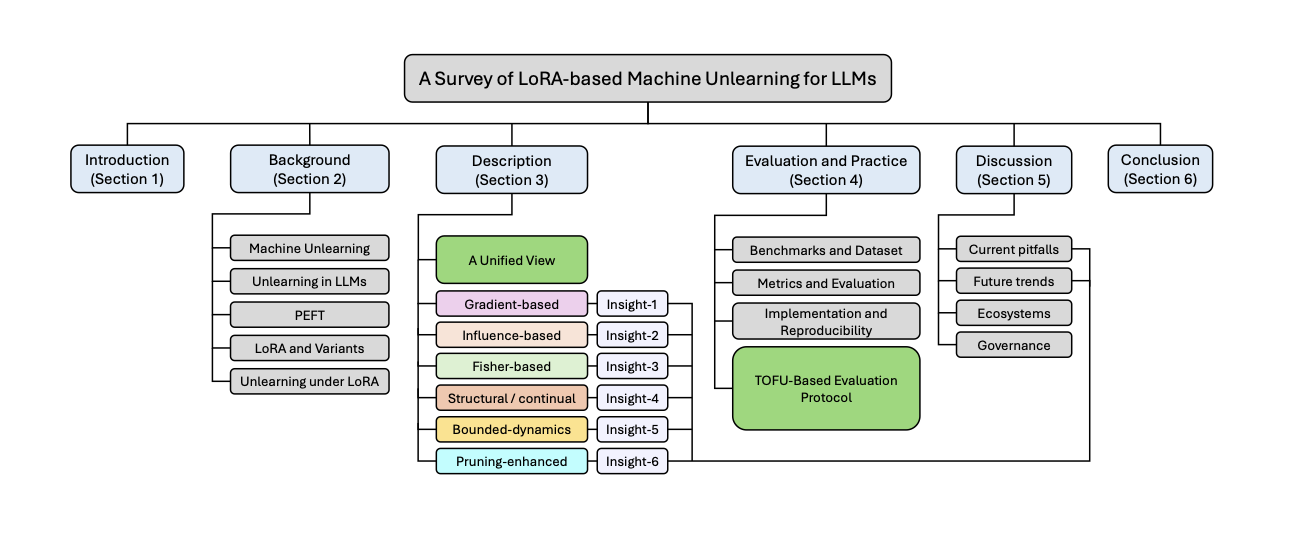
An adapter-centric problem formulation
The survey formalizes LoRA unlearning under a frozen backbone and explicit retain and forget splits, making the adapter checkpoint the locus of deletion.
A unified operator view
Methods are decomposed into score construction, preconditioning, projection, bounding, and masking for coherent cross-family comparison.
A six-family taxonomy
Existing approaches are organized into gradient, influence, Fisher, structural, bounded-dynamics, and pruning or sparse variants.
Evaluation and deployment guidance
The paper consolidates TOFU-style reporting, utility and privacy trade-offs, continual deletion behavior, and governance concerns.
Abstract
Why LoRA-based unlearning deserves its own survey
Machine unlearning is becoming a practical requirement for deployed LLMs, but many existing techniques assume full-model access and retraining budgets that are difficult to sustain in real systems.
Modern adaptation pipelines increasingly rely on parameter-efficient fine-tuning, especially LoRA modules attached to a frozen backbone and distributed as lightweight checkpoints.
This survey focuses on adapter-centric forgetting: how deletion requests can be implemented primarily in LoRA space, how method families trade forgetting against retention, and what those choices imply for privacy leakage, continual updates, and operational governance.